
 Week 5 of the Fall Intern Class meets Monday, 08 October 2012 at 6:00 PM in the Wilson County UT/TSU Extension Office on Baddour Parkway.
This week’s discussion will be over Chapter 8: Turfgrass
.
wcmg
Week 5 of the Fall Intern Class meets Monday, 08 October 2012 at 6:00 PM in the Wilson County UT/TSU Extension Office on Baddour Parkway.
This week’s discussion will be over Chapter 8: Turfgrass
.
wcmg
.
Farmer Gary Wagner walks into his field where the summer leaves on the sugar beet plants are a rich emerald hue — not necessarily a good color when it comes to sugar beets, either for the environment or the farmer. That hue tells Wagner that he’s leaving money in the field in unused nitrogen fertilizer, which if left in the soil can act as a pollutant when washed into waterways, and in unproduced sugar, the ultimate product from his beets.
The leaf color Wagner is looking for is yellow. Yellow means the sugar beets are stressed, and when the plants are stressed, they use more nitrogen from the soil and store more sugar. Higher sugar content means that when Wagner and his family bring the harvest in, their farm, A.W.G. Farms, Inc., in northern Minnesota, makes more dollars per acre, and they can better compete on the world crop market.
To find where he needs to adjust his fertilizer use—apply it here or withhold it there—Wagner uses a map of his 5,000 acres that span 35 miles. The map was created using free data from NASA and the U.S. Geological Survey’s Landsat satellites and tells him about growing conditions. When he plants a different crop species the following year, Wagner’s map will tell him which areas of the fields are depleted in nitrogen so he can apply fertilizer judiciously instead of all over.
A farmer needs to monitor his fields for potential yield and for variability of yield, Wagner says. Knowing how well the plants are growing by direct measurement has an obvious advantage over statistically calculating what should be there based on spot checks as he walks his field. That’s where remote sensing comes in, and NASA and the U.S. Geological Survey’s Landsat satellites step into the spotlight.
http://www.nasa.gov/mission_pages/landsat/news/sweet-spot.html
Have a good weekend
Once king of eastern forests, the American chestnut was wiped out by blight. Now it is poised to rise again.
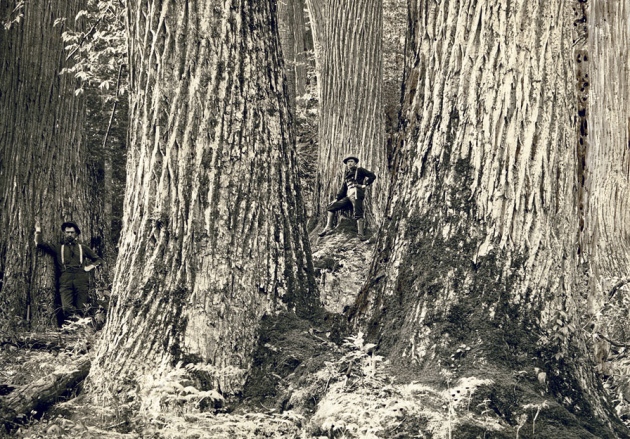
Before the fall: American chestnuts in the Great Smokey Mountains of North Carolina in 1910.
COURTESY OF THE FOREST HISTORY SOCIETY, DURHAM, NORTH CAROLINA
From giants to stumps
Once known as the sequoia of the east, the American chestnut was one of the tallest trees in the forest, and dominated a range of 800,000 square kilometres, from Mississippi to Maine (see ‘Felled by a fungus’). It made up 25% of the forest, and its annual nut crop was a major source of food for both animals and humans. The decay-resistant wood was also used to make telephone poles, roofs, fence posts and parts of railway lines.
The first warning signs came in 1904, when rust-coloured cankers developed on chestnuts at the Bronx Zoo in New York. Zoo forester Hermann Merkel took a sample across the street to the New York Botanical Garden, where mycologist William Murrill soon identified the spores as chestnut blight. The blight probably hitched a ride on nursery imports of Japanese chestnuts beginning in 1876. Spreading through rain and air, fungal spores infected trees through bark wounds and breaks. Cankers developed, quickly encircling a branch or trunk and cutting off the supply of water and nutrients from the soil. Within 50 years, the blight had laid waste to nearly the entire population of some 4 billion trees. … READ MORE
www.nature.com/news/plant-science-the-chestnut-resurrection-1.11504
 That’s right, transparent soil. Scientists have developed a see-through soil for use in in situ 3D imaging of living plants and root-associated microorganisms. The clear soil is already being used to study food-bourne human pathogens on fresh produce, and could prove useful in studying root development, root-microbe interactions, nutrient uptake in plants, and the spread of crop diseases, among many other fields of study.
The complete study is available free online at: http://www.plosone.org/article/info:doi/10.1371/journal.pone.0044276 and also available for download in Adobe PDF format here: Transparent Soil for Imaging the Rhizosphere





UT Extension

TSU Extension

Tennessee Master Gardener
 Wilson County Master Gardener Association
You must be logged in to post a comment.